

Roses are red, violets are blue, we have some Valentine’s inspired bugs, we’d love to share with you.
Valentine’s Day is a day filled with love & appreciation, and celebrated with flowers & sweets. Typically bugs are not the first thing that comes to mind when thinking about Valentine’s, however, I have curated a list of five Valentine’s inspired bugs (albeit some are more of a stretch than others) that share similarities to the symbols of this holiday.
Hopefully you will learn about some bugs you may not have heard of before or will learn something new about the familiar creatures!
Table of Contents:
1. Lovebugs
2. Kissing Bug
3. Heartworms
4. Spiny Flower Mantis
5. Cocoa Tussock Moth
Final Thoughts
1. Lovebugs
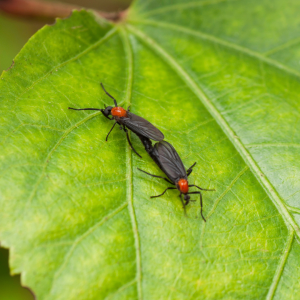
First on our list is the lovebug! Did you know “lovebug” isn’t just a phrase, but actually refers to a real type of insect? The lovebug (Plecia nearctica) is known by many other aliases, such as; march fly, double-headed bug, and the honeymoon fly. The lovebug receives its name from its unusual form of mating behavior, as pictured above. When two lovebugs mate they connect their “tails” and become stuck together for up to several days, eating, flying, and still completing daily tasks all while stuck together. Seen as being overly “clingy” to one another, that’s how this insect earned the moniker “lovebug”.
Thought to have originated from South America, lovebugs are now common throughout the Southeastern United States and were once considered an invasive species, however, lovebugs cannot bite/harm humans (unlike some on this list), yet are still considered a nuisance by some. Adult lovebugs are attracted to decomposing plant matter which sadly smells similarly to exhaust fumes to the flies, which causes them to swarm roadways where they collide with oncoming vehicles.
2. Kissing Bug
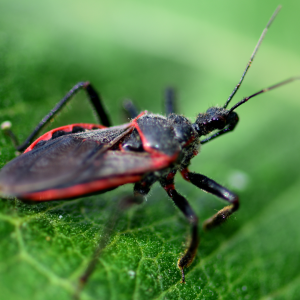
While lovebugs are benign & harmless, the kissing bug is anything but! Kissing bugs (Triatoma family) are a serious pest as they transmit a deadly disease, known as Chagas Disease, to their hosts. This nocturnal parasite goes by several other names, such as: vampire bugs & conenose bugs in English and vinchucas, chinches, barbeiros, pitos, and chipos in Spanish. Initially originating from South America, 11 different species of kissing bugs are now prevalent in 29 different states in the United States that can all carry & transmit Chagas Disease.
Kissing bugs are nocturnal and hide away during the hotter daylight hours. At night, they emerge to feed as it is cooler. Like mosquitoes and other biting insects, kissing bugs are primarily attracted to CO2 emissions from our breath, and also follow heat & odors given off by the human body. The kissing bug earns its name from the location of where it bites it host, as they primarily bite humans on the face, or near the lips. Feeding can last up to several minutes and bites do not actually cause pain, and many victims are asymptomatic, while some experience anaphylaxis. Kissing bugs do not only feed on humans, but will also feed on an array of wild animals & domestic pets alike, and are capable of spreading Chagas Disease to these hosts as well.
Chagas Disease, caused by the parasite Trypanosoma cruzi (T. cruzi), is very sneaky at first because many symptoms will not show early on during its “acute phase”. Symptoms of this phase include: flu-like symptoms, fever, rash/swelling around bite(s), and even severe swelling of the eyelids. If left untreated, T. cruzi parasites will spread throughout the body and the disease will enter its “chronic phase” which can take place over many years. Symptoms worsen as more organs become infected, such as: heart complications, chest pain, fatigue, trouble swallowing, among others.
3. Heartworms
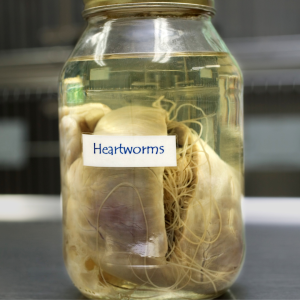
Hearts are one of the most common symbols of Valentine’s Day, so heartworms had to be included on this list! Heartworms, specifically Dirofilaria immitis, are a common parasite of dogs, cats, and ferrets. In addition to infecting pets, heartworms are also found in a few different wild animals, such as: wolves & coyotes (and other canids), bears, and even sea lions. Heartworms can also be called dogworms, as that is their preferred host. Heartworms can infect humans, but our bodies are unsuitable for them, causing the parasites to die at early stages in their life cycle.
Heartworms can grow up to a foot long (30 cm) and live up to 7 years, circulating throughout the bloodstream to affect the lungs, liver, and even the kidneys of its host. These creatures are transmitted via mosquitoes, as baby heartworms (known as “microfilaria”) infect mosquitoes who are feeding on an infected host. These mosquitoes then bite un-infected hosts and transmit the microfilaria, where they will continue to breed and grow.
Heartworms are mainly found in warmer climates where mosquitoes are more prevalent, however, due to Climate Change, heartworms are now found in virtually all states within the US, and are found on every continent throughout the world.
4. Spiny Flower Mantis
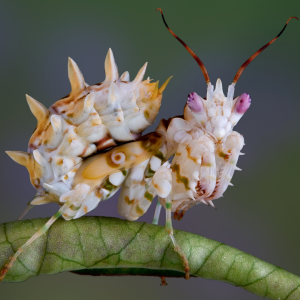
Following two rather unsightly & unpleasant creatures, is the beautiful spiny flower mantis! This unique mantid species (Pseudocreobotra wahlbergi) hails from Southern & Eastern Africa and only grows to about 1 1/2 in (40 mm). Like other mantis species, the spiny flower mantis is considered beneficial, as it preys on a variety of insects, including some that are considered garden pests.
The spiny flower mantis comes in a variety of colors: white (as pictured above), green, purple, pink, red, and yellow. They also have “eyes” on their wings that they use to scare away larger predators, that have many different colors as well: black, white/cream, and green mixtures. Spiny flower mantises hunt by mimicking flowers, lying in wait on actual flowers till would-be prey passes by.
5. Cocoa Tussock Moth
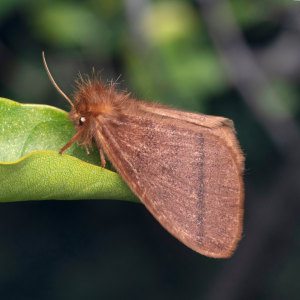
Our final bug inspired by Valentine’s is the fuzzy cocoa tussock moth! This cute little guy (orgyia postica) thrives in tropical habitats and is native to Southeastern Asia, where it feeds on a variety of plant species. The caterpillar larva of this moth also share its fuzziness and are slightly colorful. My positive take on the cocoa tussock moth may be slightly upsetting to any cacao farmer readers, as this moth is considered a pest of cacao trees, however, only an “occasional” rather than a “major” pest.
The caterpillars of this moth are quite voracious (as most caterpillars are) and if enough mass their damage could be enough to cause defoliation of cacao trees. The adults do not eat nearly as much their larvae, yet they also occasionally feed on the leaves of cacao trees. They gain their “occasional” invader status as they feed on a variety of plants, cacao only being one of them, and do not typically cause significant damage, only minor, to the trees.
Final Thoughts
Hopefully you enjoyed learning about some unique & interesting creatures, even if some were not as pleasant as others. It is fun to write about the natural world and share the topic of bugs, as they are often avoided & misunderstood.
If you would like to read more articles, please check into our Bug Blog so you won’t miss the next one.
Thank you for reading and I hope you have a wonderful Valentine’s Day!